
I Tested The EarMidus Roll-On For 2 Weeks Expecting A Scam. Here Are 7 Things That Proved Me Wrong.

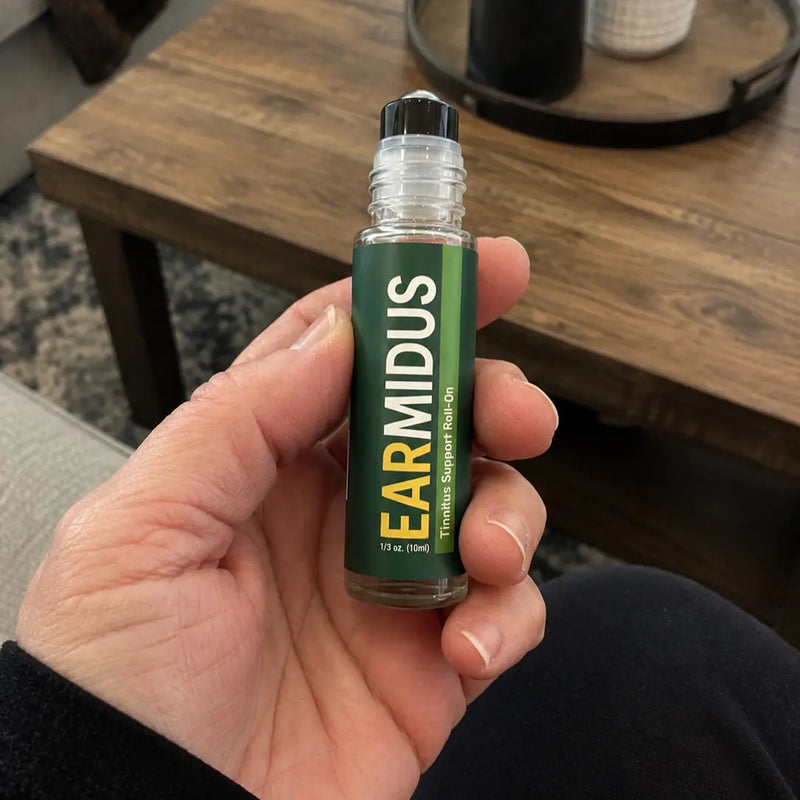
1. The doctors didn't care about my tinnitus. They didn't even check the right thing.
The three doctors I saw over thirteen years all said the same thing. "There's nothing we can do. Try some white noise. You'll get used to it."
One of them handed me a brochure for therapy — to help me accept the ringing. Not stop it. Accept it.
Not one of them ever checked the actual cause. They shined a light in my ears. Confirmed no infection. Shrugged.
Nobody mentioned that tinnitus isn't an ear problem — it's a nerve problem. It's happening in the pathway between your inner ear and your brain. And those nerves can be supported.
The pills failed for the same reason. They're all aimed at "ear health" when the problem is in the nerves. And even if they were aimed correctly, they physically can't get there — the inner ear is protected by a biological wall called the blood-labyrinth barrier that filters almost everything out.
The doctors don't treat it. They manage it. The pills can't reach it. And you're told to make peace with the noise.
I've made peace with a lot of things in my life. This didn't have to be one of them.

2. The ringing isn't coming from your ears.
Turning the TV up doesn't help. Earplugs don't help. A silent room makes it louder. Some people can change the pitch just by clenching their jaw.
If the ringing was in your ears, none of that would make sense.
What I found about the real cause changed everything. After years of loud noise, age, stress, inflammation, and reduced blood flow, the nerve fibres between your inner ear and your brain misfire, sending phantom signals to the brain even when there is no real sound.
The brain has no other way to interpret those signals, so it reads them as ringing.
That's why turning up the TV doesn't help — volume isn't the problem. That's why it's louder in silence — the nerves never stop misfiring, and you can't silence it with noise.
I spent thirteen years thinking I had broken ears. The ears were fine. It was the nerves behind my ears that had been misfiring the whole time.
That changes what you'd reach for.
3. The Skin Behind Your Ear Is the Most Absorbent on Your Body.
This is the part that made the skeptic in me put her hands down.
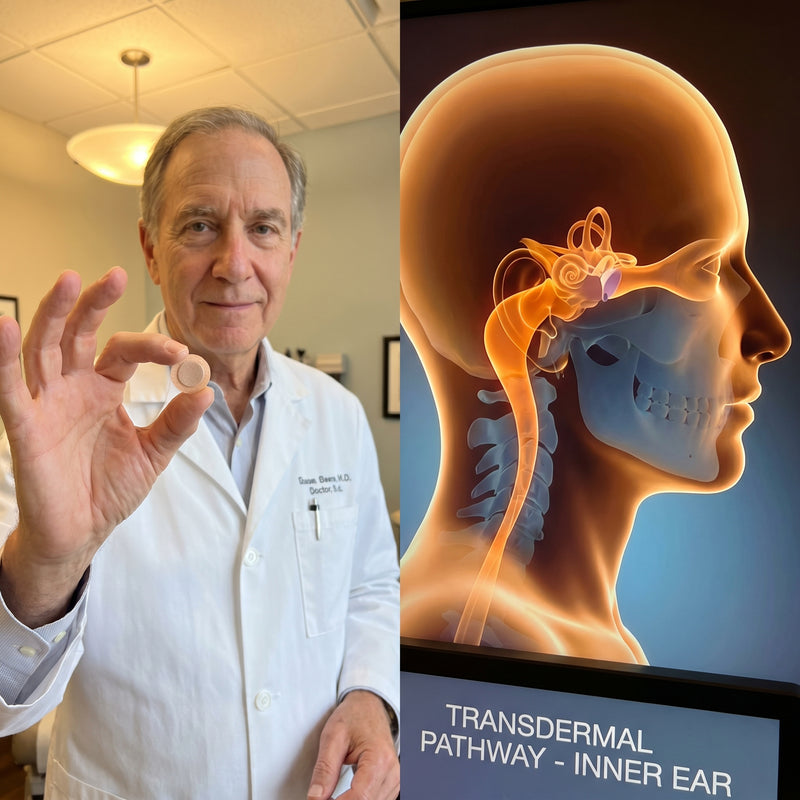
The skin behind your ear is one of the thinnest, most absorbent areas on the human body. And it just happens to sit directly over the inner ear, where the misfiring nerves sit.
There's a direct line from the skin behind your ear to your inner ear. The FDA approved that exact spot for delivering medication via the scopolamine patch — the motion sickness patch people wear on cruises.
If you're thinking a roll-on can't possibly reach the inner ear — that's the answer. It isn't reaching it through the bloodstream. It's reaching it through the closest external point on your body to the place that needs help.
The pharmaceutical industry figured this out decades ago. Nobody bothered to tell the rest of us.

4. The B vitamin I'd already tried for my tinnitus was the wrong form.
You've probably seen the ads. Vitamin B1 for tinnitus. Bottles in the pharmacy. Promoted posts on Facebook. Supplement companies promising the ringing will fade if you just take enough.
I bought a few, years ago. They did nothing. So when I saw B1 in EarMidus, my first thought was: I've already done that.
Then I read more carefully.
Regular B1 — the kind in every B-complex on the shelf — is water-soluble. It can't pass through the fat-based membranes that protect your nerve cells. The B vitamins in those bottles couldn't physically reach the nerves they were sold to support.
The companies aren't lying about B1 being good for nerves. They're just selling you the version that can't reach them.
EarMidus uses Benfotiamine — the fat-soluble form of B1. It penetrates five times deeper into nerve tissue. German doctors have prescribed it for nerve recovery for decades.
There's a reason the supplement aisle is full of cheap B-complex and almost no benfotiamine. It's more expensive to make.
EarMidus puts the version that actually reaches the nerves directly behind your ear. The right form, in the right place.
5. Four natural ingredients. One job.
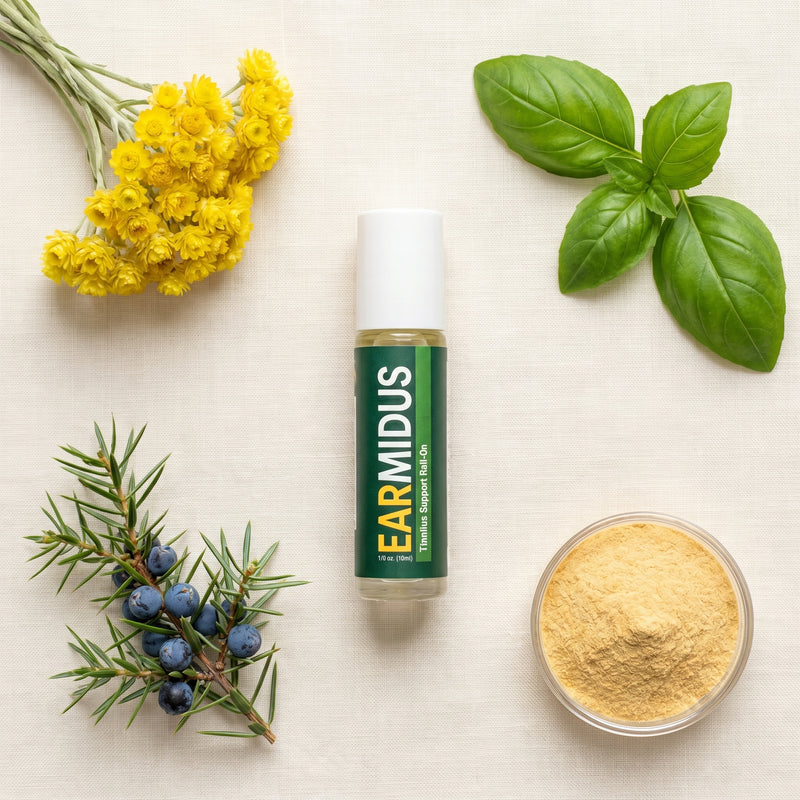
When I read what was actually in EarMidus, one ingredient stopped me: helichrysum.
It's a small Mediterranean flower — used in European medicine for centuries, called "the everlasting flower" because the blooms never wilt. What it actually does: opens blood flow.
That matters because reduced blood flow to the tiny structures in your inner ear is one of the things that makes tinnitus louder over time. The nerves in there are starving. They get louder the longer they're ignored.
Helichrysum opens the circulation. The benfotiamine I mentioned earlier feeds the nerves once the blood is finally reaching them.
Centuries-old plant. Modern form of B1. Same place. Same nerves. And the ringing I thought I'd live with for the rest of my life finally started to fade into the background.
6. What actually happens, week by week.
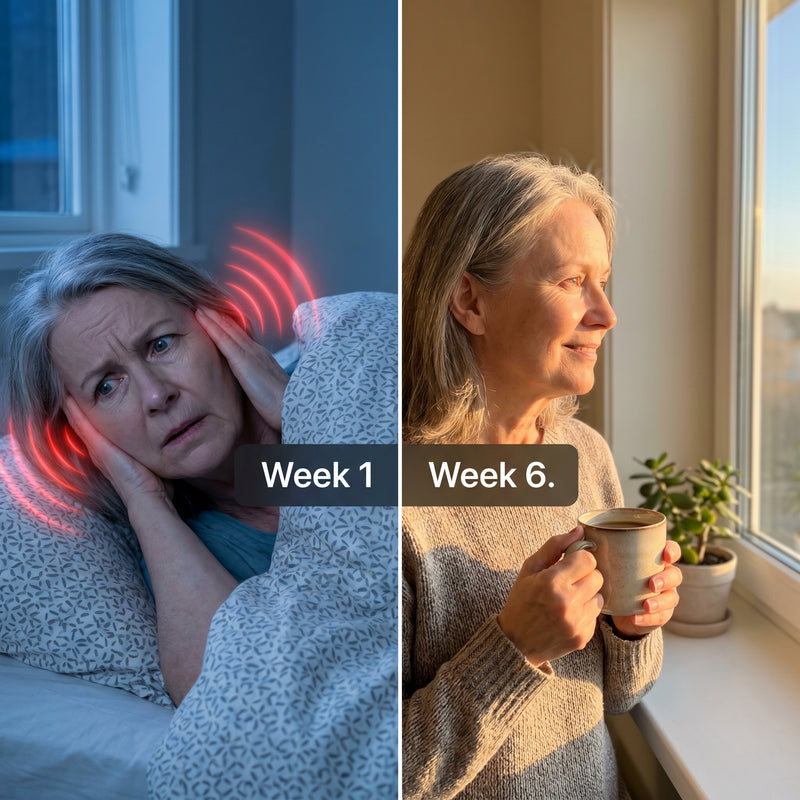
Weeks 1–2: Circulation opens. The nerves are being fed for the first time in years. Most people feel the first hints of relief, even if minor.
Weeks 3–5: The nerves start to respond. The ringing fades. You start having mornings where it's barely there, and afternoons where you forget about it.
Weeks 6–9: The misfiring settles. The ringing finally takes a back seat — quieter, softer, easier to ignore. You'll have whole stretches of the day where it doesn't cross your mind. The peace you'd given up on is the kind of peace that quietly comes back.
I'm five and a half weeks in. On Tuesday I sat by the window with my coffee and realised I'd stopped doing my usual habit of "checking" the ringing. Just sitting there.
I had not had a Tuesday like that in thirteen years.
If tinnitus has been with you for years, a few weeks is small in comparison.

7. The reason I'm writing this now — and not in a month.
EarMidus is made by a small team. Small batches. Hand-filled. They've sold out four times this year — and each restock takes two months.
I almost didn't get my second bottle. By the next morning, it was showing low stock again.
Here's the part I'd ask you to sit with. The nerves in your inner ear don't improve on their own. The longer they misfire unchecked, the more set-in the ringing becomes. The trajectory is downward — not a neutral one.
The team behind EarMidus is currently running a thank-you offer for the thousands of people who've found relief — Buy 2 bottles, Get 1 Free.
And if it doesn't work for you — for any reason — they'll refund you within 30 days. The worst case is you get your money back. The best case is you get back something you'd accepted you'd never have again.
There's a second now, when I open my eyes in the morning, and I realise I have the quiet I was wishfully hoping for every day when I had tinnitus.
Don't be like me and wait any longer. Give your nerves the support they need.
